Yrr
The SwarmThe Yrr is a distributed intelligence inhabiting the ocean, composed of countless amoebas that can gather into visible, changeable forms and share information across a collective. Its influence is associated with a global wave of marine attacks and ecological disasters, but its discovery complicates the idea of a conventional enemy: the Yrr is not one animal or one mind in a familiar body, but a form of life whose scale, memory, and communication challenge human assumptions about intelligence. The novel’s central reversal is that humanity’s search for extraterrestrial life has overlooked an intelligence already sharing Earth, in the largely unexplored world beneath the sea.
Identity and Discovery
The name Yrr begins not as a formal scientific classification but as a working label coined by Sigur Johanson. While thinking through the new theory at a meeting, he types the name accidentally, decides it will do for the moment, and keeps the idea to himself until he is ready to present it. When Judith Li explains the name to officials, she identifies its accidental origin: Johanson’s fingers slipped on the keyboard. The label nevertheless travels from private shorthand into official use, giving a name to a threat that the humans have not yet understood.
That naming follows a widening recognition that the unfolding crises are connected. Whales attack and sink ships; mussels foul vessels’ rudders; toxic, eyeless crabs contaminate Long Island’s water supply; and the collapse of the North Sea shelf kills thousands in Europe. Johanson argues that these events are not isolated natural disasters. In his account, attacks on different fronts keep human societies occupied with immediate emergencies, obscuring the larger pattern and threatening to overwhelm their ability to respond. He goes further, proposing that humanity is being treated as a pest to be eliminated. That is a grave interpretation of the attacks, not an explanation established by the Yrr’s own testimony at that point.
Johanson’s broader hypothesis changes the scale of the conflict. The ocean is not merely a setting or a storehouse of resources but an immense, poorly explored domain whose inhabitants may possess intelligence. He presents the Yrr as an ancient nonhuman species that has existed in the sea while human beings developed on land. His claim is that two radically different systems of intelligent life have coexisted on Earth, but human destruction of another species’ habitat has helped turn that coexistence into conflict. The discovery recasts the apparent invasion: the supposed aliens did not arrive from space, but from a part of their own planet that humans barely know.
A Body Without a Fixed Shape
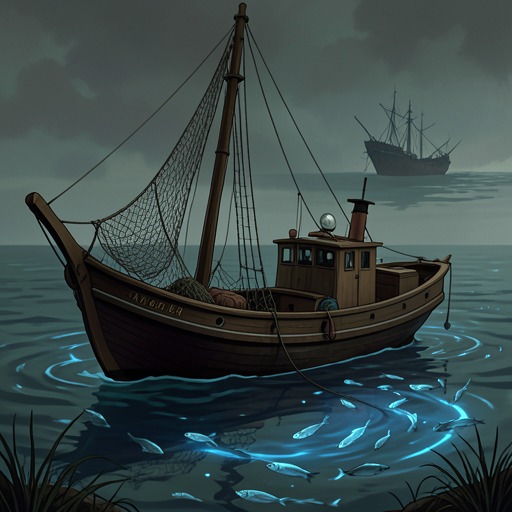
The early evidence seems to divide the Yrr-related phenomenon into separate things: an amorphous jelly, a blue cloud, and the creatures whose behavior changes around them. Material taken from the Barrier Queen links the jelly to tissue found in the brains of attacking whales and to a trace of slime associated with lobsters. The sample dissolves when exposed to air, making it difficult to study, while the area around the isolated vessel glimmers blue. Researchers call the unexplained luminous phenomenon the blue cloud, a provisional name that reflects how much remains unknown.
The apparent distinction between jelly and cloud falls away when the scientists examine the material more closely. Sigur Johanson realizes that it consists of ordinary deep-sea amoebas rather than an exotic, visibly distinct organism. Their cells can disperse and then reassemble: the jelly may lose its recognizable shape altogether, only to come together again. This makes the Yrr hard to locate by ordinary means. A sample that looks like a single mass can be a temporary gathering of cells, while individual cells can be dispersed among the much larger background of marine microorganisms.
The Yrr’s transformations make this organizational principle visible. In a tank, a mass changes from a dolphin-like shape to something resembling a skate, then to a snake-like form; it breaks apart into tiny, synchronized shapes and gathers again. Nearby clumps join the activity, as if the changes are spreading through them. The display does not establish that the Yrr literally become the animals they imitate. It shows that an aggregate can assume and vary recognizable forms at extraordinary speed, making shape a temporary expression of collective activity rather than a stable body.
The physical mass is also vulnerable. A large aggregation stranded in the well deck turns white and begins to dissociate as water drains away. Its tendrils spread across the basin, but the mass is dying; because it consists of billions of amoebas, saving it becomes a matter of preserving as much of the collective as possible. Elsewhere, a tank containing two and a half tonnes of collected organic matter holds both large aggregated clumps and countless individual amoebas. The contrast between a visible, apparently enormous creature and its dispersed cellular constituents is central to understanding the Yrr: size and shape belong to the aggregation, not to a single organism.
Collective Intelligence and Communication
The Yrr is described as a collective intelligence. Its organization is compared with bacterial aggregation: Sue Oliviera explains how Myxococcus xanthus cells can emit a starvation signal, with a stronger signal as more cells experience the same condition. Once the signal reaches a threshold, the swarm draws together into a visible structure. The analogy gives the researchers a way to think about how separate cells might coordinate, although the Yrr’s capacities extend far beyond the familiar example.
The scientists identify a Yrr pheromone and find that they can synthesize it. Their account proposes a simple function for this chemical: over short distances it can summon free-floating amoebas, which lack eyes and ears, into an aggregation. The scientists do not know exactly what initiates the gathering or how communication proceeds once aggregation has occurred. At that stage of their understanding, the signal seems to carry a single instruction: aggregate. The simplicity of the chemical signal contrasts with the complexity of the intelligence that emerges when cells assemble.
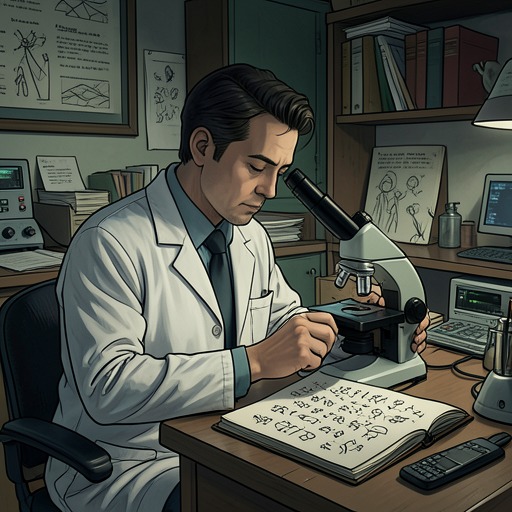
Human researchers also test whether the Yrr can understand deliberate communication. Murray Shankar sends mathematical exercises, including sequences, logarithms, and missing numbers, as a kind of intelligence test. The Yrr return correct answers. Samantha Crowe interprets the result as evidence both that Scratch is a language carrying complex information and that the Yrr can adapt it so humans can understand. The exchange demonstrates not merely that the Yrr received a signal, but that it can decode a human task and construct a legible reply.
That response leads Crowe to send a more elaborate message describing humanity, its evolution, and its culture. She persuades Jack Vanderbilt that the humans have little to lose by explaining themselves, and argues that presenting this information may give the Yrr a reason to reconsider humanity’s fate. Communication therefore becomes more than a scientific experiment: it is an attempt to make human history intelligible to another intelligence at a moment when the relationship is already marked by destruction and conflict.
Learning, Memory, and the Individual Cell
Research into the Yrr’s DNA reveals a puzzle beneath its outward resemblance to ordinary amoebas. The cells appear alike, but comparisons of their DNA show that some short, hypervariable regions differ unpredictably. The differences are too large to be explained by background mutation alone. Although the researchers do not decode the full genome, the diagnostic sequences point to active variation rather than random genetic noise. The discovery gives biological substance to the idea that the Yrr’s cells may change through a process connected to learning.
Karen Weaver and Leon Anawak develop a model by programming virtual amoebas with electronic DNA that continues to mutate. In their simulation, individual cells possess basic information about their environment, while some cells receive additional information. Cells with matching codes aggregate first. When collectives with different codes join, they can exchange information and update one another, adopting a shared code; further unions produce still larger bodies of knowledge. The model is a computer experiment, not proof of the Yrr’s exact biology, but it offers a way to imagine how learning could occur across a population without depending on a single central brain.
As the virtual cells face increasingly complex problems, they aggregate more often, devise strategies not programmed in advance, and begin to work creatively. They can imitate and vary living forms, develop sensitive feelers, examine objects at a minute scale, and share each experience with every cell. The point of the model is not simply that the cells cooperate. A useful discovery made anywhere in the collective becomes available to the whole, allowing accumulated experience to guide later action.
The characters describe this as a form of inherited experience. According to Johanson’s explanation, the Yrr do not receive abstract knowledge from the past alone; they inherit experience as though they had undergone it themselves. Their collective memory reaches back to the first Yrr. Anawak distinguishes this structure from human individual consciousness: a cell can act as a sensor, register an experience, and contribute it to the collective, but a thought counts only if its impulse is strong enough to enter the shared system. Competing inputs are weighed, and the fittest survives. The model leaves room for local creativity while locating durable knowledge in the collective rather than in a single, enduring individual.
Conflict, Death, and the Meaning of the Collective
The pheromone that brings cells together also has a lethal function. The researchers reason that defective Yrr cells, unable to provide the correct signal, are excluded from aggregation. Since amoebas reproduce by division, exclusion alone would not prevent a faulty cell from multiplying. The pheromone can bind to a universal receptor and act as a fast-acting toxin, inducing programmed cell death. In the researchers’ account, this is a way to prevent defective cells from reproducing and compromising a species that continually learns and evolves.
This mechanism changes how the Yrr’s apparent violence can be understood. The collective does not describe its treatment of faulty cells as a war within its own society. Karen Weaver’s later account frames it as the expulsion and death of diseased or defective cells, comparable to a body shedding dead skin. Millions or billions of cells may form what is, in this sense, a single being. Collectives with individual queens can still belong to a vastly larger living system, with a world-spanning memory and no one cell granted permanent preference. There may be mistakes, but the account does not attribute moral blame to the system or describe its internal processes as punishment or conflict between individuals.
The danger of that system becomes acute when humans attempt to exploit its signaling. Mick Rubin warns that the synthesized pheromone can trigger a chain reaction: once it binds to cells and initiates programmed death, aggregation can spread the effect. A signal that normally draws the Yrr together can therefore become a means of destroying them. The prospect turns biological understanding into a weapon and exposes the risk of treating a collective organism as though its signals were simple switches that humans can safely control.
The novel’s larger conflict thus remains morally and conceptually unsettled. Human characters call the Yrr an enemy, infer that it may intend humanity’s annihilation, and consider military action; others argue that contact and negotiation are necessary. The Yrr’s demonstrated capacity to answer mathematical questions makes it difficult to dismiss as an unconscious natural force, while its distributed form resists the human expectation of a single speaker or representative. Its collective life also complicates the language of war: acts that appear to target a creature may affect billions of cells, and the distinction between organism, population, and mind does not hold steady.
The Ocean as a World of Its Own
The Yrr’s significance is bound to the novel’s contrast between human visibility and oceanic life. The continental shelf is only a shallow underwater continuation of the landmass; beyond its edge, the depths become an unknown universe. Even advanced remotely operated vehicles can explore only within specific limits, while the vast water column and seafloor remain difficult for people to observe directly. The Yrr’s dispersed cells, temporary aggregations, and unfamiliar modes of signaling make those limits more consequential: the intelligence may be present without taking a form that human instruments or expectations readily identify.
The sea also connects the Yrr to consequences that cross scales. A chemical signal operates among cells; an aggregation can change shape; influence on marine animals becomes visible in attacks on ships; and those attacks occur alongside ecological damage and disruptions to human societies. The novel repeatedly makes local incidents legible as parts of a wider pattern, while leaving the ocean’s internal life only partially accessible. This mismatch—humanity’s capacity to affect marine habitats set against its inability to understand all that lives there—forms the ground of the Yrr conflict.
At the novel’s conclusion, Karen Weaver is certain that the Yrr remember everything, and the phrase that the Yrr are memory condenses the species’ distinctive existence. The collective is enormous, present wherever there is water, and associated with a history vastly older than humanity’s. It is neither simply an animal that can be confronted nor an abstract intelligence detached from bodies: it is a living network of cells whose memory, learning, and action are distributed across the ocean. By making the Yrr both a threat and a radically different form of life, the novel asks whether human beings can make room for intelligence that does not resemble an individual human mind—and whether they can recognize that intelligence before their own actions make coexistence impossible.